With the continuous advancement of the construction industry, H-beams have emerged as a cost-effective and high-performance structural steel product. Thanks to their optimized cross-sectional geometry and superior mechanical properties, H-beams have become a core material in modern steel structure buildings, including industrial plants, commercial buildings, and large-span bridges.
Compared with traditional I-beams, H-beams offer clear advantages in section modulus, structural stability, connection efficiency, and material utilization, enabling a steel-saving rate of approximately 10%–40% under comparable load conditions.
What Is an H-Beam?
An H-beam is a structural steel section characterized by:
A right-angle arrangement between the web and flanges
Wide, parallel, and uniform flanges
A cross-section resembling the letter “H”
This geometry provides higher bending resistance, improved load distribution, and easier bolted or welded connections compared to conventional I-beams.
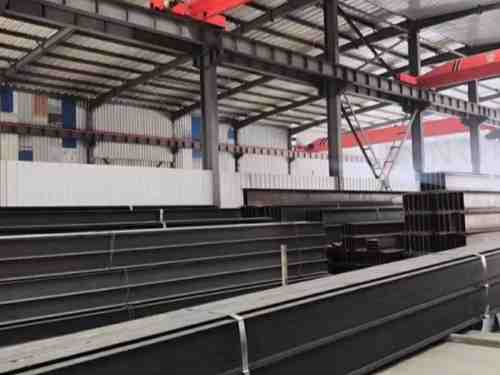
Main Types of H-Beams by Flange Width
Based on flange width and height-to-flange ratio, H-beams are commonly classified into three categories:
- Wide-FlangeH-Beam (HW)
Height ≈ Flange width
Primarily used as columns in steel structures
Often embedded as core columns in reinforced concrete frame systems
Suitable for high axial load and compression-bearing applications
- Medium-Flange H-Beam (HM)
Height-to-flange width ratio: approx. 1.33–1.75
Commonly used as:
Steel frame columns
Frame beams subjected to dynamic or equipment loads
Frequently applied in industrial platforms and machinery-support structures
- Narrow-Flange H-Beam (HN)
Height-to-flange width ratio ≥ 2
Mainly used as beam members
Functional equivalent to traditional I-beams, but with better connection convenience
Classification of H-Beams by Manufacturing Process
- Hot-Rolled H-Beams
Manufactured using hot rolling technology
Typically combined with micro-alloying and TMCP (Thermo-Mechanical Controlled Processing)
Features:
Stable mechanical properties
High dimensional accuracy
Tight tolerances exceeding common industry standards
Maximum web height can reach up to 1200 mm
Widely used in standardized building and infrastructure projects
- Welded H-Beams
Fabricated by welding steel plates
Advantages:
Flexible design
Customizable sizes and section dimensions
Suitable for:
Non-standard structures
Heavy-load or oversized components
Special engineering requirements
H-Beam Size Classification (by Web Height H)
- Large H-Beams (H ≥ 700 mm)
Typical size: 700 × 300 mm
Applications:
Long-span bridges
High-rise building main structures
- Medium H-Beams (300 mm ≤ H < 700 mm)
Typical size: 500 × 200 mm
Applications:
Industrial plant frames
General steel structure buildings
- Small H-Beams (H < 300 mm)
Typical size: 200 × 200 mm
Applications:
Secondary structural members
Mechanical supports and auxiliary structures
Special-Purpose H-Beams
- Low-Alloy High-Strength H-Beams (e.g., Q355B)
High yield strength
Good toughness and seismic performance
Suitable for:
Seismic fortification zones
Heavy industrial environments
Weathering and Fire-Resistant H-Beams
Enhanced through alloy design
Improved corrosion resistance or fire performance
Commonly used in:
Chemical platforms
High-temperature workshops
Outdoor exposed steel structures
Conclusion: How to Choose the Right H-Beam
H-beams can be classified by flange width, manufacturing process, size, application, material grade, and applicable standards. Each type focuses on different performance priorities:
Hot-rolled H-beams: ideal for standardized construction projects
Welded H-beams: suitable for customized, heavy-duty, or non-standard designs
HW / HM / HN sections: optimized respectively for columns, general structures, and beam applications
National, American, European, and Japanese standard H-beams: meet regional engineering and design specifications
Selecting the appropriate H-beam type ensures the optimal balance between structural safety, load-bearing performance, construction efficiency, and cost control, making H-beams an indispensable component of modern steel structure engineering.
FAQ
FAQ 1: What is an H-beam?
An H-beam is a structural steel section with wide, parallel flanges and high load-bearing efficiency for steel structures.
FAQ 2: What is the main advantage of H-beams?
H-beams provide higher bending strength, better stability, and improved material efficiency compared to traditional I-beams.
FAQ 3: What are HW, HM, and HN H-beams?
HW, HM, and HN classify H-beams by flange width and height ratio for column, general, and beam applications.
FAQ 4: Are H-beams used as columns or beams?
H-beams can be used as both columns and beams, depending on flange width, section size, and load requirements.
FAQ 5: Hot-rolled vs welded H-beams: which to choose?
Hot-rolled H-beams suit standardized projects; welded H-beams fit customized or heavy-load structural designs.

 English
 Español