Quick Overview
The difference between cold drawn and hot rolled seamless steel pipes lies in processing temperature, dimensional precision, and application focus.
Cold Drawn Seamless Steel Pipe: High precision, smooth surface, higher strength
Hot Rolled Seamless Steel Pipe: Larger sizes, better ductility, lower cost
Engineering Rule:
Precision & fit → Cold Drawn Seamless Steel Pipe
Capacity & cost → Hot Rolled Seamless Steel Pipe
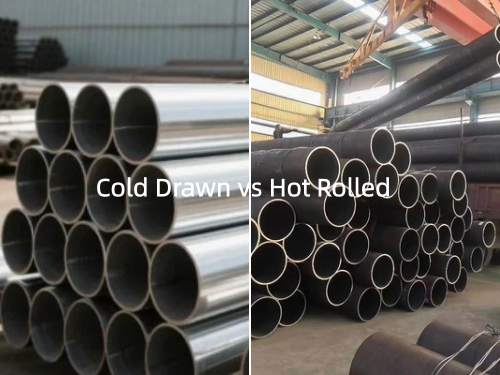
-
Key Engineering Differences Between Cold Drawn and Hot Rolled Seamless Steel Pipe
In seamless steel pipe selection, the decision is not about which process is better—but which is more suitable for the application.
Hot Rolled Seamless Steel Pipe: Formed above recrystallization temperature (>900°C)
Cold Drawn Seamless Steel Pipe: Processed at or near room temperature
This difference directly affects:
Dimensional tolerance
Surface condition
Mechanical performance
Machining requirements
-
Core Performance Comparison of Cold Drawn vs Hot Rolled Seamless Steel Pipe
|
Property
|
Cold Drawn Seamless Steel Pipe
|
Hot Rolled Seamless Steel Pipe
|
|
Processing Temperature
|
Room temperature
|
>900°C
|
|
Dimensional Accuracy
|
High (tight tolerance)
|
Moderate
|
|
Surface Finish
|
Smooth
|
Rough
|
|
Yield Strength
|
Higher (+10–20%)
|
Lower
|
|
Ductility
|
Lower
|
Higher
|
|
Residual Stress
|
Present
|
Minimal
|
|
Size Range
|
Small–medium diameters
|
Wide (including large diameters)
|
|
Cost
|
Higher
|
Lower
|
|
Typical Use
|
Precision components
|
Structural & pipeline systems
|
-
Application Differences of Cold Drawn vs Hot Rolled Seamless Steel Pipe
Cold Drawn Seamless Steel Pipe for Precision Applications
Used where tight tolerance and surface finish are critical.
Typical applications:
Hydraulic cylinders
Precision sleeves and bushings
Automated machinery components
Key focus: Fit accuracy and reduced machining
Hot Rolled Seamless Steel Pipe for Structural and Pipeline Applications
Used where capacity, strength, and cost efficiency dominate.
Typical applications:
Oil & gas pipelines
Structural supports
Large-diameter fluid transmission systems
Key focus: Load capacity and scalability
-
Selection Considerations for Cold Drawn and Hot Rolled Seamless Steel Pipe
When to Choose Cold Drawn Seamless Steel Pipe
Tight tolerance required
Smooth surface needed
Direct assembly applications
Small to medium diameters
When to Choose Hot Rolled Seamless Steel Pipe
Large diameter requirements
Structural or heavy-duty applications
Cost-sensitive projects
Need for higher ductility
Mechanical Trade-offs in Cold Drawn vs Hot Rolled Seamless Steel Pipe
Cold drawing introduces work hardening, which:
Increases yield strength by 10–20%
Reduces ductility
Creates residual stress
Environmental Considerations for Cold Drawn Seamless Steel Pipe
In corrosive environments (e.g., H₂S):
Residual stress may accelerate cracking
Stress-relief heat treatment is recommended
-
Common Misconceptions About Cold Drawn vs Hot Rolled Seamless Steel Pipe
Misconception 1: Cold Drawn Seamless Steel Pipe is Always Better
Cold drawn improves precision—not overall performance.
Hot rolled is better for:
Large diameters
Forming operations
High ductility requirements
Misconception 2: Ignoring Residual Stress in Cold Drawn Seamless Steel Pipe
Residual stress may:
Reduce fatigue life
Increase crack risk
Misconception 3: Using Cold Drawn Seamless Steel Pipe for Large Diameters
Cold drawing is typically limited to ≤200 mm OD and is not suitable for large-scale applications.
Misconception 4: Focusing Only on Strength Instead of Ductility
Cold drawn pipes are not suitable for:
Bending
Flaring
Installation deformation
-
FAQs
Q1. Is cold drawn seamless steel pipe stronger than hot rolled?
Yes. Cold drawn pipes have 10–20% higher yield strength, but lower ductility.
Q2. Can cold drawn seamless steel pipe replace hot rolled pipe?
No. Hot rolled pipes are still required for large diameter and structural applications.
Q3. How to choose between cold drawn and hot rolled seamless steel pipe?
Precision & tolerance → Cold Drawn Seamless Steel Pipe
Size & cost efficiency → Hot Rolled Seamless Steel Pipe
Q4. Is cold drawn seamless steel pipe suitable for corrosive environments?
Yes, but stress-relief heat treatment is recommended to reduce failure risk.
Q5. What is the main limitation of cold drawn seamless steel pipe?
The main limitation is restricted size range, especially for large diameters.
-
Conclusion
For engineering applications:
Choose Cold Drawn Seamless Steel Pipe for precision, tolerance, and surface quality
Choose Hot Rolled Seamless Steel Pipe for large size, structural strength, and cost efficiency
Final Insight:
The correct choice is not about process superiority, but about matching the seamless steel pipe to real service conditions.

 English
 Español